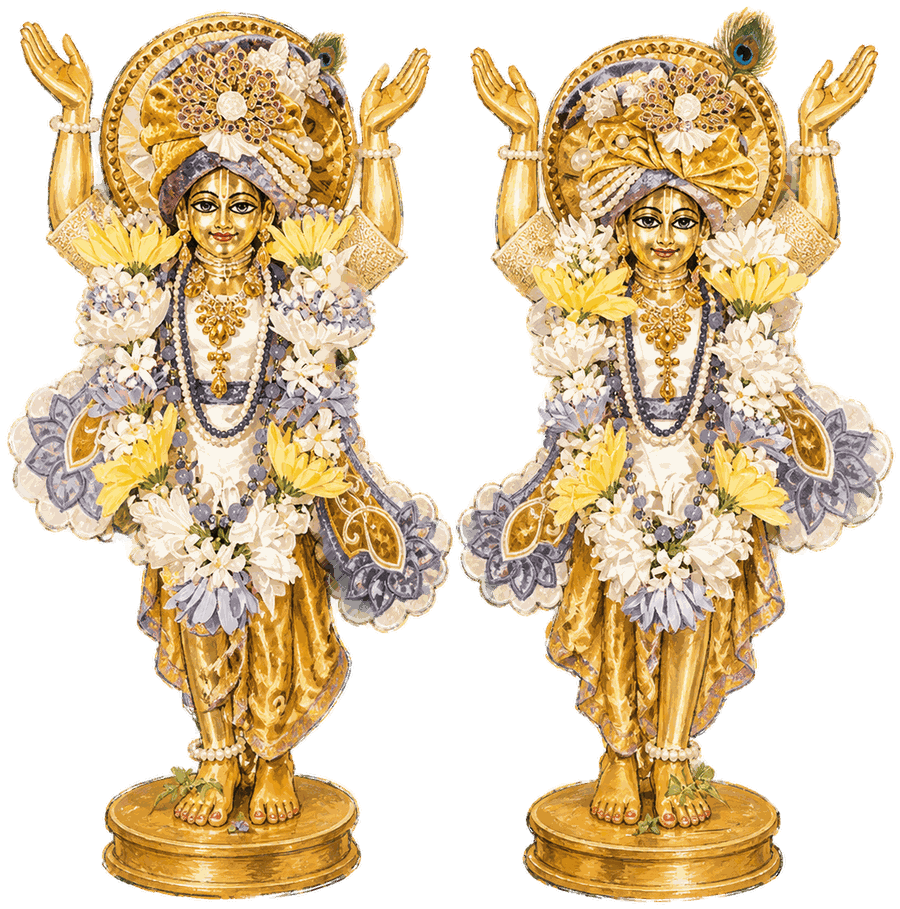
At a quarter past seven the curtain opens and the Deities — freshly dressed and decorated — appear before everyone. This is called darshan.
The service is short, only five minutes: devotees offer their obeisances to the Deities and sing the bhajan Govindam adi-purusam.
In the Vedic tradition it is held that it is not so much we who look at the Deities as They who look at us. A guest need do nothing at this moment — just stand at the back and watch.
What is sung
“Govindam adi-purusam”
Brahma-samhita, verses 5.30 and 5.32
You need not sing along — the words never change, and after a few visits they stay with you. Of the bhajan Govindam adi-purusam, two verses are sung at the greeting:
I worship Govinda, the primeval Lord, playing His flute. His eyes are like lotus petals, His head is adorned with a peacock feather, His form is the colour of a rain cloud, and His beauty charms more than that of millions of gods of love.
I worship Govinda, the primeval Lord, each limb of whose body can do what all the other senses do: He sees, maintains and creates countless universes. His form is eternal, full of knowledge and bliss.